
How to Avoid the Slippery Slope to Burnout
Burnout
Burnout builds slowly, often unnoticed, until one day you realise you are running on empty, dreading the work you once cared about, and struggling to remember the last time you felt rested.
At Ashcliffe Psychology, we see burnout across every sector we work with, from mining and FIFO to emergency services, law enforcement and corporate teams. The good news is that burnout is well researched, its warning signs are recognisable, and there are practical, evidence-informed steps you can take to stop the slide.
In this post, we explain what burnout is, why it matters and what drives it.
What is burnout?
Burnout is a response to chronic workplace stress that has not been successfully managed. The World Health Organization (WHO) includes it in the International Classification of Diseases (ICD-11) as an occupational phenomenon, not a medical condition. It sits among the factors that lead people to seek health support.
The WHO describes three dimensions of burnout:
• Exhaustion: feeling drained of energy, physically and emotionally.
• Mental distance or cynicism: feeling detached from, negative about or cynical towards your job.
• Reduced professional efficacy: feeling less effective, less capable or less accomplished at work.
While the WHO definition is specific to work, pressures at home and within ourselves often add to the load. That is why it helps to look at the whole picture when you start to feel the slide.
Burnout is more than feeling tired.
A 2017 systematic review of prospective studies published in PLOS ONE found that burnout predicted a wide range of later health and work problems:
• Physical health: higher risk of coronary heart disease, type 2 diabetes, high cholesterol, musculoskeletal pain, headaches, gastrointestinal and respiratory problems, prolonged fatigue and severe injuries.
• Mental health: insomnia, depressive symptoms, greater use of psychotropic and antidepressant medication, and hospitalisation for mental health conditions.
• Work: job dissatisfaction, absenteeism, presenteeism (being at work but not functioning well) and new disability pensions.
In safety-critical settings such as mining, FIFO, policing and emergency services, the links between fatigue, injury and reduced concentration make early recognition especially important.
What drives burnout?
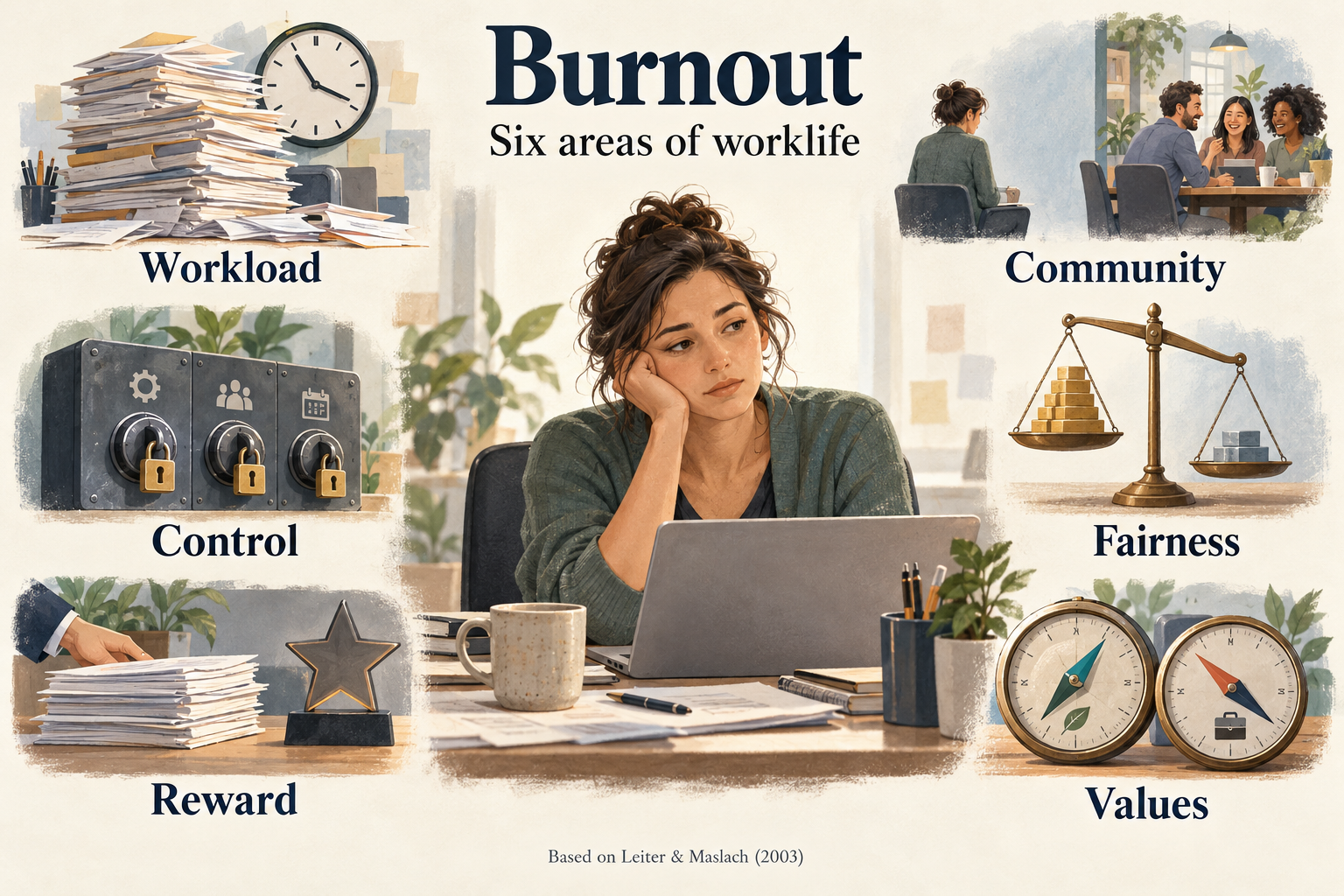
Six areas of work-life that drive burnout
Burnout grows out of a mismatch between a person and their working conditions. Research identifies six areas of worklife where those mismatches commonly occur:
1. Workload: too much work, too little time or too few resources.
2. Control: little say over how, when or where you do your work.
3. Reward: effort that goes unrecognised, financially, socially or personally.
4. Community: strained relationships, isolation or a lack of support.
5. Fairness: perceived inequity, favouritism or unjust decisions.
6. Values: a gap between what matters to you and what the job asks of you.
In Western Australia, the WorkSafe WA Code of Practice: Psychosocial hazards in the workplace names stress, fatigue and burnout among the psychosocial hazards that workplaces are expected to prevent and manage under the Work Health and Safety Act 2020 (WA).
The most effective approach combines organisational change with personal strategies. The tips below focus on what you can do as an individual, and they work best alongside a workplace that takes psychosocial safety seriously.
5 tips to avoid burnout
Here are five simple and practical ways to stop burnout before it takes hold.
Tip 1: Recognise the early warning signs
Burnout does not happen suddenly. It is a slow and steady build, so noticing the early signs gives you the best chance to change course. Signs to watch for:
• exhaustion that does not lift with rest
• a growing sense of cynicism
• detachment from your work or the world around you
• lethargy and low motivation.
If you notice these, pause and ask yourself honestly: How am I actually doing? These signs map closely onto the WHO's three dimensions of burnout, which is why they are worth taking seriously.
Tip 2: Identify what is driving you and address it in parts
Burnout usually comes from many directions at once: pressure at work, pressure at home and pressure we put on ourselves. Together, they can feel overwhelming.
It’s important to identify each contributing factor and break them into parts. Writing these down is a good way to start. We need to create space in our mind to think, and writing the issues down gives us a way to externalise our thoughts. This can help us to start to problem solve what I can see, rather than what is going around and around in my mind. Finding small steps you can take to cope with what you are experiencing may help things feel more manageable. Remember when we are overwhelmed it is difficult to think clearly. Providing space in our mind and interrupting the spiral of thoughts needs to happen in order to bring things back to healthy levels one step at a time. The six areas of worklife above (workload, control, reward, community, fairness and values) are a useful checklist to start with.
Tip 3: Make recovery an everyday practice, not a holiday reward
Many of us push hard and tell ourselves it is fine because a holiday is coming. However, that can lead to even more burnout as people may feel the need to burn the candle at both ends in order to complete everything before they take leave. The result is often getting sick, or spending those precious days off trying to wind down.
Research has found that holidays improve health and wellbeing, but the benefits fade soon after returning to work. A more recent meta-analysis found wellbeing returned to pre-holiday levels after about the first week back and recommended regular short breaks throughout the year.
Small daily habits that help you recover physically, mentally and emotionally keep your system in balance. Think regular breaks, switching off from work after hours, movement, good sleep and activities you genuinely enjoy.
Ashcliffe Psychology Counsellor Scott Alfonso takes us through 5 tips in 5 minutes on how to avoid burnout.
Tip 4: Stay connected
When life gets busy, it is easy to withdraw from the people and activities that keep us grounded, such as sports clubs, friendships and family. Yet these connections are what sustain us.
It’s important to make time for connection even when you are flat out. Catch up with friends, set aside family time or take your dog for a long walk. These moments remind us that we are not just our jobs.
The evidence for connection is strong. A landmark meta-analysis of 148 studies found that people with stronger social relationships had a 50% greater likelihood of survival, an effect comparable to well-established health risk factors.
Tip 5: Seek professional support early
This is the tip people most often fail to follow through on. Many of us tell ourselves we should be able to handle things alone, and so we wait until it is too late.
The earlier we get in front of burnout, the easier it is to bring ourselves back to healthy, manageable levels. If you know, or even suspect, that it is getting too much:
• contact your Employee Assistance Program (EAP), which is confidential and usually free for employees
• talk to the people around you
• see your GP, who can refer you to a psychologist
• seek support from a professional who can help you in an objective and healthy way.
“There is always help out there, and there is absolutely zero shame in recognising that we probably all could use just a little bit more of it in our lives”
Is it burnout, stress or something more?
Burnout shares features with stress, anxiety and depression, and they often overlap. The links between burnout and mental illness are an active area of Research. A key difference is that burnout is tied to work, while depression tends to affect every area of life. However, severe burnout can lead to depression and anxiety disorders.
It is worth seeing your GP or a psychologist if:
• low mood, hopelessness or loss of interest extend beyond work
• your sleep, appetite or concentration have changed for more than a couple of weeks
• you are relying more on alcohol or other substances to cope
• rest and time off are no longer helping.
If you are in crisis or worried about your safety, call Lifeline on 13 11 14 (24/7) or 000 in an emergency.
-
• de Bloom, J., Kompier, M., Geurts, S., de Weerth, C., Taris, T., & Sonnentag, S. (2009). Do we recover from vacation? Meta-analysis of vacation effects on health and well-being. Journal of Occupational Health, 51(1), 13–25.
• Holt-Lunstad, J., Smith, T. B., & Layton, J. B. (2010). Social relationships and mortality risk: A meta-analytic review. PLOS Medicine, 7(7), e1000316.
• Leiter, M. P., & Maslach, C. (2003). Areas of worklife: A structured approach to organizational predictors of job burnout. In P. L. Perrewé & D. C. Ganster (Eds.), Research in Occupational Stress and Well Being (Vol. 3, pp. 91–134). Emerald.
• Maslach, C., & Leiter, M. P. (2016). Understanding the burnout experience: Recent research and its implications for psychiatry. World Psychiatry, 15(2), 103–111.
• Salvagioni, D. A. J., Melanda, F. N., Mesas, A. E., González, A. D., Gabani, F. L., & de Andrade, S. M. (2017). Physical, psychological and occupational consequences of job burnout: A systematic review of prospective studies. PLOS ONE, 12(10), e0185781.
• We continue to recover through vacation! Meta-analysis of vacation effects on well-being and its fade-out. TU Dresden research portal.
• WorkSafe WA. (2025). Psychosocial hazards in the workplace: Code of practice.
• World Health Organization. (2019). Burn-out an "occupational phenomenon": International Classification of Diseases.
-
DISCLAIMER: The information provided in these blog posts is intended for general educational and informational purposes only. It is not a substitute for professional psychological assessment, diagnosis, or treatment. Individuals should not rely upon this content as professional advice, nor should it be used to guide or replace clinical decision-making.
Although all content is written by qualified mental-health professionals and draws upon contemporary psychological research and recognised frameworks (e.g., APS Code of Conduct 2025; AHPRA Guidelines for Advertising Regulated Health Services, 2020), the material may not apply to every person or circumstance. Psychological needs are highly individual, and effective care requires a personalised clinical assessment. Reading these posts does not create a therapeutic relationship with Ashcliffe Psychology or any of its clinicians. In an emergency, call 000 or attend your nearest emergency department. If you are experiencing distress, concerned about your mental health, or require support, please contact a registered health professional. Ashcliffe Psychology makes no warranty regarding the accuracy, completeness, or applicability of the content at any point in time. Blog posts may refer to sensitive topics and may be updated or removed as needed to ensure compliance with professional and regulatory standards.
Use of Artificial Intelligence: Ashcliffe Psychology may utilise artificial intelligence (AI) tools in limited circumstances to support content development. Any material generated or informed by AI undergoes review by qualified clinicians to ensure accuracy, legitimacy, and alignment with professional, ethical, and regulatory requirements before publication.
